Counting the points
One pin down scores its number, two or more scores how many fell. The full Mölkky scoring rule, with worked examples and the edge cases.
Updated August 13, 2026 · 4 min read
Mölkky has two scoring modes. Knock over exactly one pin and you score the number printed on it — the 12 pin is twelve points. Knock over two or more pins and you score how many fell, not their numbers: the 9, 11 and 12 together score three, not thirty-two. Knock over nothing and you score nothing.
The two modes, in full
| What fell | You score | Example |
|---|---|---|
| One pin | The number on it | The 7 alone → 7 points |
| Two or more pins | The count of pins | The 3, 8 and 12 → 3 points |
| Nothing | 0, and a miss is recorded | — |
That is the entire scoring rule. Everything else on this page is consequences of it.
Why the count, not the sum?
Because the sum would make the game trivial. If knocking over 9, 11 and 12 scored thirty-two, the correct strategy in every game would be "throw as hard as possible into the middle", and there would be no decisions left to make.
The count rule inverts the incentive. A big scatter is worth little. Early in a game, when the pins are still touching, a hard throw that flattens six of them is worth six points — respectable, but no better than isolating the 6. And the more the formation spreads out, the more valuable precision becomes, because picking off a single high pin cleanly is the only way to score above six.
There is a pleasing symmetry in it: knocking over all twelve pins at once scores twelve, exactly the same as knocking over just the 12. One is a demolition, the other is a surgical shot, and the game values them identically.
Worked examples
You are on 0. The 12 falls alone. Score 12. Running total: 12. The best possible opening throw.
You are on 12. Five pins fall. Score 5 — not their numbers. Running total: 17.
You are on 44. The 6 falls alone. Score 6. Running total: 50 exactly. You win.
You are on 44. The 9 falls alone. That would be 53. You do not win, and you do not stay on 44 — your score is set back to 25.
You are on 44. The 9 and the 3 both fall. Two pins fell, so the score is 2. Running total: 46. This is the throw a good player aims for when they need a small number: a pair is worth two whatever the pins are, which makes it far easier to hit than any specific low pin.
What counts as knocked over
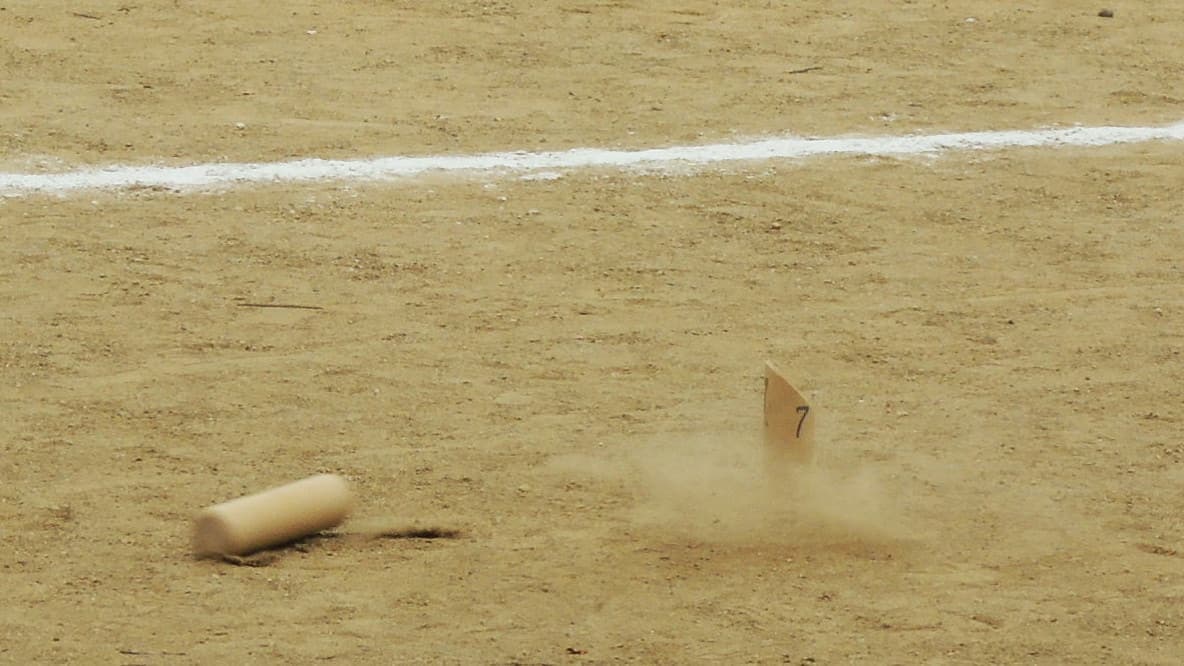
A pin scores only when it is lying flat on the ground. In practice:
- A leaning pin does not count. Resting on another pin, on the mölkky, or on a tuft of grass — it is still standing. Set it upright on its own spot.
- A pin knocked over by another pin counts. It does not matter what hit it.
- A pin knocked outside the playing area counts, and is stood back up where it stopped.
- A pin the mölkky simply comes to rest against does not count, unless it has actually gone over.
Disputes are nearly always about leaners. The workable convention: if you have to ask, it is standing.
After the throw
Every pin that fell is stood back upright where it came to rest — not back in formation. This is not a scoring rule, but it changes what future scores are available more than anything else does, so it belongs in the same breath.
Round one, the pins touch and a five-pin throw is easy. Round eight, they are spread across three metres and a five-pin throw is nearly impossible — but the 12 is standing alone with a clear line to it. The scoring stays the same all game; what changes is which scores you can realistically reach.
Keeping score on paper
If you are counting by hand, write each player's running total, not the individual throws. The number that matters is the distance to fifty, and a column of throws forces everyone to re-add it every turn.
Mark a miss with a dot next to the total, so three dots in a row is visible at a glance. Clear the dots the moment a player scores.
Or don't keep score on paper
The app handles the two scoring modes, the exact-fifty target, the drop back to twenty-five and the three-miss count. Add names and start in ten seconds.
Open the scorekeeperRelated
Reaching exactly fifty — why going over costs you twenty-five points, and how to play the last few throws. The twelve pins — where each number stands, and why that layout makes the scoring rule work.
Frequently asked questions
How do you score in Mölkky?
If exactly one pin falls, you score the number printed on it. If two or more fall, you score the number of pins that fell, not the sum of their numbers. If none fall, you score nothing.
Does knocking over the 12 and the 11 score 23?
No — it scores 2. Two pins fell, so the score is the count. The numbers only matter when exactly one pin falls.
Does a leaning pin count in Mölkky?
No. A pin only counts as knocked over if it is lying flat on the ground. A pin leaning on another pin, or against the throwing stick, is still standing and is set back upright on its own spot.
What is the highest score from one throw in Mölkky?
Twelve — by knocking over the 12 pin and nothing else. Knocking over all twelve pins at once scores twelve as well, which is the neat symmetry at the heart of the scoring rule.
Keep reading
The 12 pins of Mölkky
A Mölkky set has twelve pins numbered 1 to 12, set out in four rows. Here is the exact layout, the sizes, and why twelve.
Reaching exactly fifty
You must land on exactly fifty to win Mölkky. Go over and your score drops to twenty-five. Here is why, and how to play the endgame.
Three misses and you are out
Three scoreless throws in a row eliminates a player in Mölkky. Here is the official rule, and the reset variant most families actually use.
The rules of Mölkky
The complete official Mölkky rules — scoring, the exact-fifty target, three misses, order of play and the common house variants.
Let the app do the counting
Exactly fifty, the drop back to twenty-five, three misses and out. Add names and start scoring in ten seconds — no account, no signal needed.